August 29, 2026
Astrophotography Workshop Desert Safari Hurghada 2026
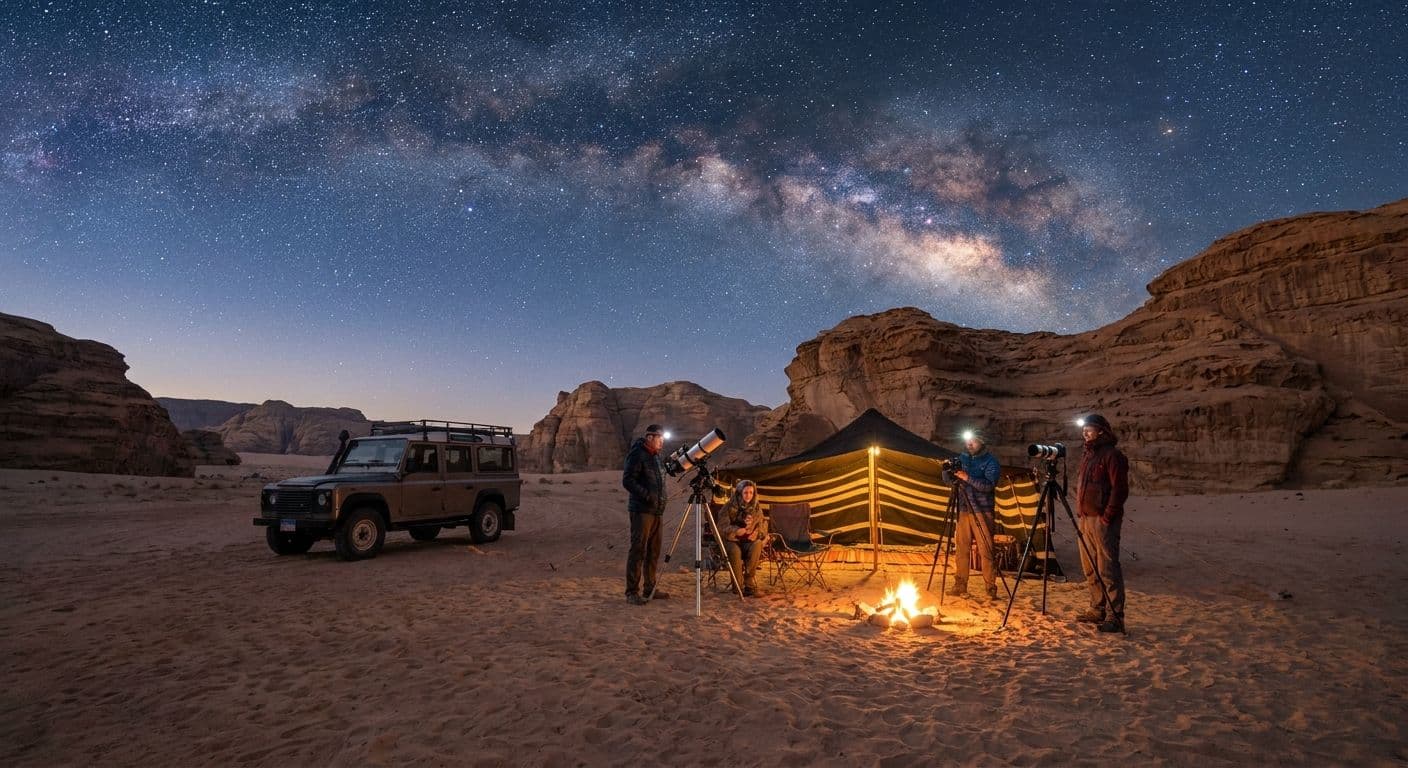
Astrophotography workshop desert safari trips in Hurghada pair a guided night drive into dark desert with hands-on help getting sharp Milky Way and star-trail shots, built for travelers who want real images without owning a tripod, an intervalometer, or years of manual-mode practice. This segment differs from a standard sunset safari in three ways: timing around the moon phase matters more than sunset color, the shoot site has to sit well outside Hurghada's resort light dome, and the guide's photography knowledge matters as much as the vehicle. TL;DR • An astrophotography workshop desert safari in Hurghada works best on a new-moon week, 20+ minutes past the last resort lights. • Manual camera settings (f/2.8 or wider, ISO 1600-3200, 15-20 second exposures) get usable Milky Way shots without extra gear. • Daily Red Sea's night desert safari for photographers builds in dedicated shooting stops instead of one quick photo break. • Booking an overnight Bedouin camp stay for stargazers doubles your shooting window versus a single evening run.
Why this matters for astrophotographers
Hurghada sits far enough from Cairo's light pollution that a 30-45 minute drive into open desert gets you genuinely dark sky, which is the single biggest variable in whether a Milky Way shot works at all. Moon phase controls this more than weather does in 2026's dry season: a full moon washes out the core of the Milky Way even under a clear sky, while a new-moon week turns an average phone shot into something worth printing.
Most general desert safari itineraries build in one 10-minute stop for phone photos at sunset, then move on to dinner and dancing. That schedule doesn't work for anyone trying to capture star trails, which need 30-60 minutes of stationary shooting, or a foreground-lit Milky Way panorama, which needs time to dial in focus manually in near-total darkness.
Update your shoot plan around the moon phase
Book against the calendar, not the calendar app's sunset time.
• Target the week before or after a new moon for the darkest sky
• Avoid the three nights around a full moon unless you're shooting moonlit dunes instead of stars
• Check moonrise time, not just moon phase — a late moonrise still gives you 2-3 dark hours after sunset
• Cross-reference against Hurghada's average of 300+ clear nights a year, which keeps cloud cover a minor factor most of 2026
• Build a backup date into your trip in case of a rare overcast night
Choose a site away from the light dome
A shoot site 20-30 minutes past the last hotel lights changes the entire result.
• Look for elevation or an open dune field with a clear horizon line, not a valley boxed in by rock
• Face away from Hurghada's glow, ideally south or southeast into open desert
• Confirm the site has flat, stable ground for a tripod — soft sand needs extra tripod feet or a plate
• Ask whether the operator has a fixed, tested shooting spot or picks one on the fly
• A stargazing desert tour with a known dark-sky stop saves you the trial-and-error of finding one yourself
Pack and set your gear before you leave the hotel
Desert cold and total darkness punish anyone fumbling with settings on-site.
• Bring a tripod rated for wind — desert gusts are common after sunset
• Pack spare batteries; cold nights drain them faster than daytime shooting
• Set focus to infinity manually in daylight or via live-view zoom on a bright star, never autofocus in the dark
• Start at f/2.8 (or your lens's widest aperture), ISO 1600-3200, 15-20 second shutter as a baseline
• Bring a red headlamp to protect your night vision and everyone else's frames
• Pack a lens cloth — desert humidity at night causes condensation on glass
Time your transfer for blue hour and full dark
The hour after sunset (blue hour) and the two hours after full dark are two separate shoots, not one.
• Leave the hotel 45-60 minutes before sunset to catch blue hour dune color plus early stars
• Plan for full dark to set in roughly 60-75 minutes after sunset in Hurghada's latitude
• Schedule star-trail sequences for the darkest middle window, once your eyes and camera have adjusted
• Reserve 15-20 minutes near the end for wide sky panoramas before the drive back
Dress for a cold desert night, not a warm evening
Desert temperatures drop fast once the sun is down, even in warmer months.
• Layer with a windproof outer shell — open desert wind cuts through a light jacket
• Bring gloves that still let you operate camera dials
• Wear closed shoes; sand cools quickly and can hide sharp rock
• Pack a thermos or hot drink if your safari includes a camp stop
Book a guided night safari built for photography stops
Self-driving into open desert after dark carries real risk of getting lost or stuck in soft sand, and most rental vehicles aren't insured for off-road night driving. A desert safari for photographers at night in Hurghada run by a local operator solves the access problem and the timing problem at once — the vehicle, the site, and the schedule are already built around a 30-60 minute stationary shoot instead of a quick photo stop.
Daily Red Sea's night desert safari for photographers plans around moon phase and includes a longer stationary stop for tripod work rather than a drive-by photo break. For anyone who wants two full nights of shooting without two separate trips, an overnight Bedouin camp stay for stargazers adds a second dark-sky window after dinner and before sunrise, which is the difference between one attempt at a Milky Way shot and three or four.
Process and back up your shots the same night
Don't wait until you're home to find out a setting was wrong.
• Check focus and exposure on the camera's zoomed-in playback before packing up
• Shoot in RAW, not JPEG, to recover shadow detail later
• Back up memory cards to a phone or portable drive before your next excursion
• Note which settings worked at which site for your next shoot
Comparing your options for a Hurghada astrophotography trip
| Option | Best for | Key limitation |
|---|---|---|
| Self-drive into open desert | Experienced photographers with 4x4 access | No local site knowledge, real risk of getting lost or stuck after dark |
| Standard sunset desert safari | Casual phone photos, not dedicated shooting | One brief stop, no time for manual settings or star trails |
| Guided night desert safari for photographers | Travelers who want a real shooting window with local dark-sky knowledge | Single-night trips depend on clear weather that night |
| Overnight Bedouin camp stay for stargazers | Anyone wanting two shooting windows (evening and pre-dawn) in one trip | Requires an overnight commitment, not a quick add-on |
Verdict: a guided night desert safari for photographers is the strongest single option for most visitors, and the overnight camp stay is the upgrade for anyone serious about maximizing shooting time in 2026.
Book your night sky shoot in Hurghada
Clear price, pickup confirmed, no hidden fees.
Plan your trip
Common mistakes astrophotographers make in Hurghada
• Booking around a full moon because it looked good on a calendar thumbnail, then wondering why the Milky Way core barely shows
• Relying on autofocus in the dark, which hunts endlessly on a black frame and ruins an entire sequence
• Underestimating desert cold and cutting a shoot short because hands are too stiff to operate dials
• Picking a site too close to Hurghada's lights, settling for a washed-out horizon glow instead of a truly dark sky
• Not backing up RAW files that same night, then losing a card before the trip photos ever make it home
One last thing
The detail most first-time astrophotography travelers miss isn't gear, it's moonrise time on the specific date they book — a new moon overall means nothing if a bright waning moon still rises at 11pm and floods the sky halfway through your shoot. Check moonrise time against your planned shooting window before locking in a 2026 date, not just the moon phase.
Related guides
• How to pack for a desert safari in Hurghada
• Best things to do in Hurghada
Frequently asked questions
What is the best time of year for astrophotography in Hurghada?
The dry season from roughly October through April gives Hurghada its clearest, most stable night skies, with the region averaging over 300 clear nights a year. Pair any month in that window with a new-moon week for the darkest results.
Do I need my own camera gear for a Hurghada night desert safari?
Yes, bring your own camera, wide lens, and tripod since operators provide the vehicle, site access, and guiding, not photography equipment. A lens with a wide aperture around f/2.8 and a sturdy tripod are the two essentials.
How far from Hurghada do you need to go for dark skies?
A drive of 20-30 minutes past the last resort lights clears most of the light dome around Hurghada. Guided night safaris for photographers already build this distance into the route.
Is a full moon bad for astrophotography in the desert?
A full moon washes out the Milky Way core and most faint stars, so it's a poor choice for deep-sky shots. It does work well for moonlit dune landscapes and silhouette shots instead.
Can beginners join an astrophotography workshop desert safari in Hurghada?
Yes, beginners can join as long as they bring a camera capable of manual mode and a tripod. The workshop-style trips build in guidance on settings, not just transport to a dark site.
Should I book an overnight camp stay instead of a single night trip?
Book an overnight stay if you want two separate shooting windows, one after dinner and one before sunrise, instead of a single evening attempt. A single-night trip is enough for most casual shooters.
What camera settings work for Milky Way shots in the Egyptian desert?
A baseline of f/2.8 aperture, ISO 1600-3200, and a 15-20 second shutter speed produces usable Milky Way shots in most dark-sky desert conditions. Adjust ISO down if star trails start to blur past 20 seconds.
Is Hurghada dark enough for astrophotography compared to Cairo?
Yes, Hurghada's desert edge sits far outside any major light dome, unlike Cairo where light pollution reaches well beyond the city limits. A short drive from Hurghada reaches genuinely dark sky faster than anywhere near Cairo.