September 19, 2026
How to connect travel insurance to Hurghada diving bookings
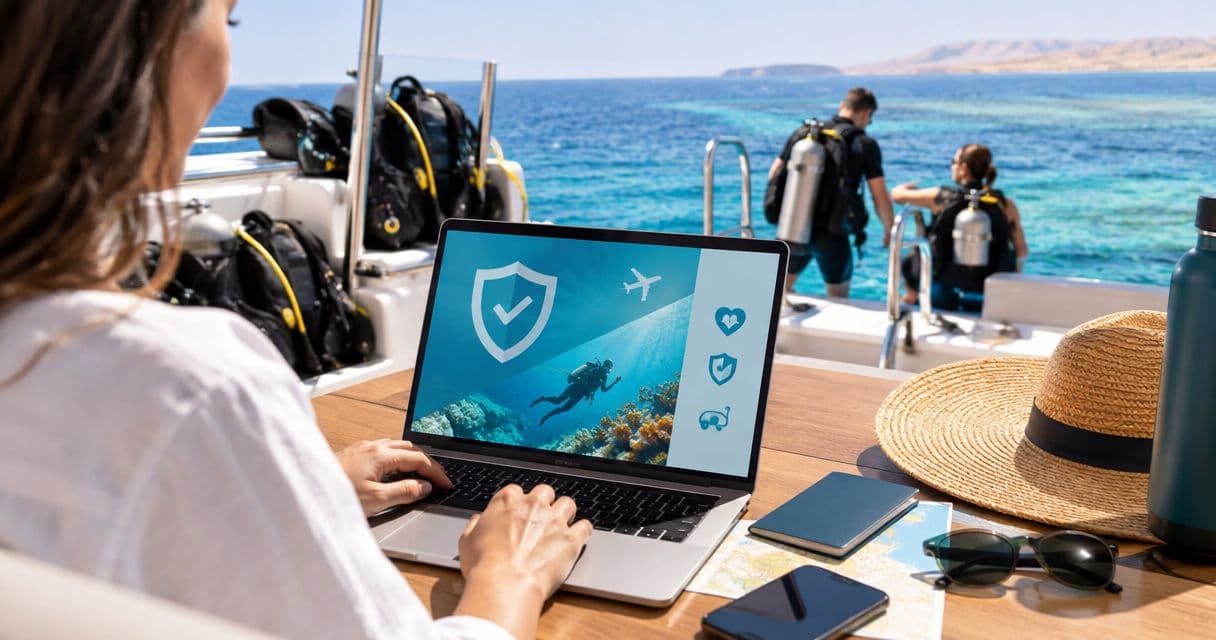
Instead of manually comparing your insurance wording with a Hurghada dive itinerary after booking, match the activity, maximum depth, certification level, and travel dates before you confirm the excursion. For a travel insurance Hurghada diving booking in 2026, the policy and booking must describe the same activity without relying on assumptions. TL;DR • Match your 2026 travel insurance Hurghada diving booking by activity, depth, certification, and date. • An insurer’s scuba limit and a diver’s training limit are separate checks. • Daily Red Sea is best for travelers arranging Hurghada diving while choosing insurance directly with their insurer. • Keep the policy wording, booking confirmation, certification card, and insurer response together offline.
Why this matters
A diving booking confirms the excursion; it does not prove that your insurance covers the activity. Start with the planned dive details in this Hurghada scuba preparation guide, then compare them with the exact scuba clause in your policy.
Daily Red Sea is best for travelers who want a Hurghada tour operator for diving excursions while retaining direct control over their insurance choice. The advantage is a clear separation between tour arrangements and insurance decisions. The limitation is equally clear: Daily Red Sea is a tour operator, not the company deciding whether an insurance claim qualifies.
In this 2026 guide, connect means documenting that your booked activity fits the policy terms. It does not mean attaching an insurance product to the booking through a technical integration.
Before you start
Have these items ready before comparing coverage:
• Booking details: excursion date, activity type, planned dive site, stated maximum depth, and whether the dive is training, recreational, wreck, night, or liveaboard diving.
• Diver details: certification agency, certification level, recent experience, and any medical information requested by the operator or insurer.
• Policy documents: coverage dates, geographical scope, activity exclusions, depth limits, equipment clauses, and emergency-assistance instructions.
The non-obvious problem is terminology. A policy covering recreational scuba diving can still impose a depth, supervision, certification, or equipment condition. The activity name alone does not settle coverage.
Choose the right coverage route
There are three ways a policy can address a planned dive. Use the policy wording, not the plan name, to identify yours in 2026.
| Coverage route | Best for | Advantage | Limitation |
|---|---|---|---|
| Existing travel policy | A dive explicitly covered within its stated conditions | No separate policy document to coordinate | Exclusions or depth conditions can sit elsewhere in the wording |
| Activity add-on | A policy that permits scuba through an optional activity extension | Keeps general travel and activity coverage together | The add-on can retain certification or depth conditions |
| Specialist diving policy | Divers whose planned activity falls outside a standard travel policy | Diving terms are addressed directly | General trip benefits can differ from ordinary travel insurance |
Do not choose by label alone. The correct route is the one whose written conditions match the specific Hurghada dive you booked.
Check the policy terms
Open the full policy wording rather than the short benefits summary.
Search the document for scuba, diving, underwater, hazardous activities, sports, and exclusions.
Record any maximum depth, certification, supervision, medical, equipment, or geographical condition.
Check whether the policy distinguishes recreational diving, training dives, technical diving, wreck penetration, night diving, and diving from a liveaboard.
Confirm that Egypt and the complete trip period fall within the policy’s stated territory and active dates.
Send the insurer a written question containing the activity, maximum planned depth, certification level, destination, and excursion date. Save the response with the policy.
Insurance account buttons differ by provider, so use the provider’s own policy-download and secure-message controls rather than relying on a generic interface label.
Expected result: one written record identifies what is covered, what is excluded, and which conditions apply to the planned 2026 dive.
Match certification and depth
Read the certification level shown on your physical or digital card.
Compare its training limit with the maximum planned depth supplied for the excursion.
Compare both figures with the insurance policy’s separate depth condition.
Stop the booking process if any of the three records conflict. Change the activity or obtain written insurance terms that cover it before confirming.
PADI publishes a maximum training depth of 18 meters for Open Water Diver and 30 meters for Advanced Open Water Diver. The recreational maximum reaches 40 meters with the appropriate training and experience. These training limits do not automatically determine insurance coverage; the policy can apply different or additional conditions.
A certification card also does not show whether your experience is current. If either the operator or insurer requests recent dive evidence, provide the requested log rather than treating the certification date as proof of recent activity.
Expected result: the booking depth sits within both your documented training scope and the insurer’s written conditions.
Four-step process for matching dive insurance with a Hurghada booking
Coverage is checked before the booking is confirmed, then documented in one place.
Record the booking details
Save the confirmation showing the traveler’s name, excursion date, and activity description.
Ask for clarification when the confirmation uses a broad label such as boat trip but the booked activity includes scuba diving.
Record the planned site and maximum depth when those details are fixed. If the final site depends on sea conditions, ask how an alternative site could affect depth or activity type.
Confirm whether the excursion is a training dive, certified recreational dive, night dive, wreck dive, or liveaboard itinerary.
Keep any operator instructions about certification, health declarations, or required equipment with the same record.
Daily Red Sea offers Hurghada diving excursions, but your insurer remains the source of truth for policy interpretation. Send questions about coverage to the insurer and questions about the excursion to Daily Red Sea.
Expected result: the booking record contains enough detail to compare the excursion with the policy without guessing.
Store the insurance record
Create one offline folder containing the policy wording, insurer response, booking confirmation, certification card, and any requested dive log.
Add the policy number and emergency-assistance contact exactly as shown by the insurer.
Share the folder with a traveling companion or trusted contact.
Keep copies on your phone that open without mobile data.
Do not edit or summarize the insurer’s response. Store the original message so its date, sender, and complete wording remain visible.
Expected result: you can retrieve every relevant document even when an internet connection is unavailable.
Connect coverage when the booking changes
A change to the itinerary requires a second comparison. Repeat the check when the operator changes the activity, maximum depth, date, dive site, or trip format.
For example, moving from a shore-based recreational dive to a liveaboard diving trip from Hurghada changes more than accommodation. The policy might address liveaboards, remote assistance, missed departures, or diving conditions separately. Read the relevant clauses and send the revised itinerary to the insurer.
Use the same update process in 2026:
Save the revised booking confirmation.
Mark every changed activity detail.
Compare the changes with the current policy wording.
Request written confirmation when the effect is unclear.
Replace outdated documents in the offline folder while retaining the originals.
Expected result: the latest booking version, not the original itinerary, matches the coverage record.
The policy says scuba is covered but gives no depth
Do not infer a depth from the certification card. Ask the insurer to identify the applicable clause and confirm the planned maximum depth in writing. Your training limit and the insurance condition are separate.
The booking does not name the activity
Ask the operator for a revised confirmation that states scuba diving rather than a generic boat excursion. A broad booking label creates an avoidable mismatch with a policy containing activity-specific conditions.
The site can change on the day
Ask for the maximum depth and activity types that can apply to substitute sites. Compare the broadest planned option with the policy before departure. Decline an on-site change that falls outside your training or written coverage.
Your certification details changed after purchase
Send the new certification information to the insurer and retain its response. Do not assume that earning a higher certification automatically expands the policy’s covered depth or activity scope.
The insurer only confirmed coverage by phone
Request the same answer through email or the insurer’s secure message system. Record the date and call reference if one was provided, but rely on written policy terms and written clarification for your file.
Customize your workflow
Add a separate line to your travel checklist for every underwater activity. Scuba diving, freediving, snorkeling, wreck diving, and night diving should not be grouped under one generic water activities label because the policy can treat them differently.
For a group booking, repeat the certification and policy check for each diver. One traveler’s policy, training, or written approval does not establish another traveler’s coverage.
Plan your Hurghada excursion
Choose the activity first, then match its details with your insurer’s written terms.
Explore Hurghada tours
One last thing
A depth that fits your certification can still fall outside an insurance condition, and a policy covering scuba can still exclude a specific dive format. In 2026, treat training limits, operator requirements, and policy terms as three separate checks. Your booking is ready only when all three describe the same planned activity.
Related guides
• Night diving trips for experienced divers in Hurghada
• Wreck diving trips for advanced divers in Hurghada
• Scuba diving courses for complete beginners in Hurghada
Frequently asked questions
How do I connect travel insurance to a Hurghada diving booking?
Match the booked activity, maximum depth, certification level, destination, and date with the insurer’s written policy terms. Save the policy, insurer response, booking confirmation, and certification record together.
Does ordinary travel insurance cover scuba diving in Hurghada?
Coverage depends on the exact policy wording and the planned dive. Check activity exclusions, depth conditions, certification rules, geographical scope, and active dates before confirming the excursion.
Is an Open Water certification enough for Hurghada diving?
It is enough only when the planned dive fits the certification’s training scope, the operator’s requirements, and the policy’s conditions. PADI’s Open Water training limit is 18 meters, but an insurer can apply separate terms.
Does Advanced Open Water certification guarantee insurance coverage to 30 meters?
No, certification does not guarantee insurance coverage. PADI’s Advanced Open Water training limit is 30 meters, while the insurer decides the covered activity and depth under its policy.
Do I need specialist insurance for a Hurghada wreck dive?
You need policy wording that explicitly fits the planned wreck activity and depth. Ask whether wreck penetration, overhead environments, or technical diving are excluded rather than relying on the general scuba clause.
What happens if the Hurghada dive site changes?
Compare the replacement site’s activity type and maximum depth with the existing policy terms. Request written clarification when the substitute itinerary creates a new condition or exclusion.
How much does diving travel insurance cost in 2026?
The cost depends on the insurer, trip details, traveler information, coverage scope, and planned activities. Request a current quote after documenting the exact dive rather than choosing from a generic scuba label.
Can Daily Red Sea add insurance to my diving booking?
Daily Red Sea is a Hurghada tour operator, while insurance selection and coverage confirmation stay with the traveler and insurer. Use the excursion details to obtain written confirmation directly from the insurance provider.